Skip to contentAllen Pittman

Chinese internal arts · living transmission

Internal
Arts

Hsing-I and Ba-Gua form the technical centre of Allen’s teaching, carried in the direct transmission from Hung I-Mien. The Chen Pan-Ling family transmission stands beside it as a second distinct route; other practices inform the field without becoming equal offers.

Enter the field
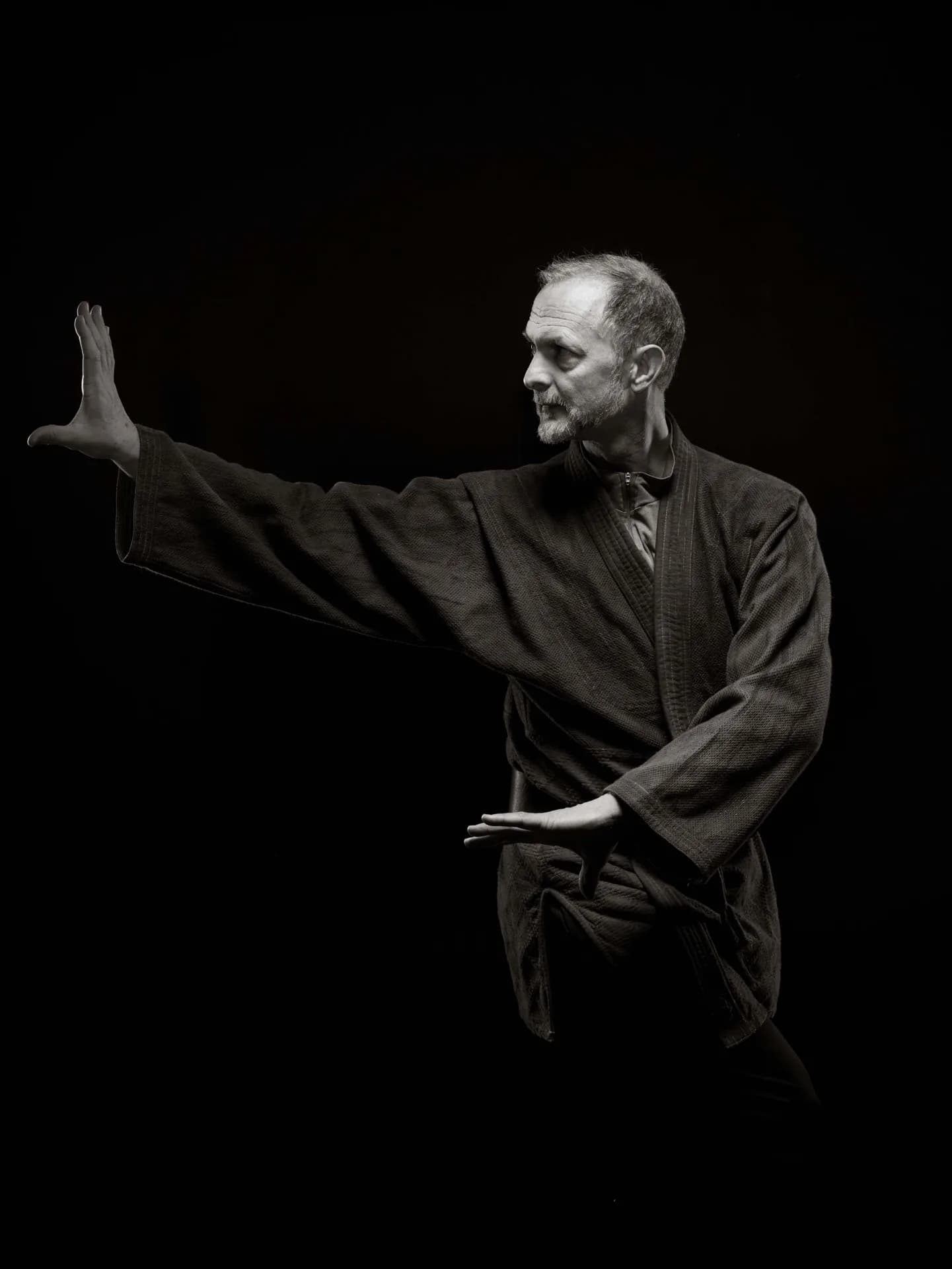
Allen Pittman practising an internal martial form
Allen Pittman · Ba-Gua Zhang

The organising principle

Form keeps a memory. Function tells us what it remembers.

Allen’s internal-arts teaching keeps provenance, structure and practical use in the same room.

The arts share questions — balance, change, force, attention, relationship — and each gives those questions a particular answer. The major routes remain visible, so the student can see what came through Hung I-Mien, what came through Smith and what came through the Chen Pan-Ling family.

The central practices

Three fields, each with its own route.

Hsing-I and Ba-Gua form the technical centre, carried through Hung I-Mien’s transmission. Chen Pan-Ling’s family transmission stands beside them as a distinct Taiwanese synthesis.

01

Straight

形意拳

Hsing-I Chuan

Hsing-I studies directness: five elements, animal strategies and power organised through the whole body. Allen’s teaching brings four clearly named encounters into conversation: long study with Robert W. Smith, direct work with Hung I-Mien, decades of counsel from Rose Li and the Chen Pan-Ling family transmission.

Smith · Hung I-Mien · Rose Li · Chen family transmissionOpen Hsing-I in the Taiwan archive
02

Curved

八卦掌

Ba-Gua Zhang

The clearest direct route runs from Gao I-Sheng through Chang Chuen-Feng and Hung I-Mien to Allen. In that curriculum the Twenty-Four Celestial Gates, Sixty-Four post-heaven hands, Eight Mother Palms and four auxiliary palms belong to one progression. Rose Li’s Ba-Gua, studied across more than two decades, and Smith’s comparative Sun, Kuo and Wang studies form parallel layers of reference.

Gao · Chang · Hung · AllenOpen Ba-Gua in the Taiwan archive
03

Synthesis

陳泮嶺

Chen Pan-Ling family transmission

Chen Pan-Ling’s method crosses Hsing-I, Ba-Gua and Tai Chi while preserving their different characters. Allen studied it directly in Taiwan with Chen’s sons, Yun-Chao and Yun-Ching, received permission from his teachers to teach what he had learned and continues to teach the method. It appears here as a living family transmission with its own history.

Chen Pan-Ling · Yun-Chao & Yun-Ching · AllenSee the distinct Chen family route

A supporting influence

Tai Chi remains in the background.

Allen has practised and studied Tai Chi, but does not present it as a primary art he currently teaches.

Principles of slowness, listening, structure and change continue to inform his work—principally through Robert W. Smith’s teaching of Cheng Man-ch’ing’s short form and push hands, and through the Chen Pan-Ling family method. Naming it here as an influence makes that contribution visible without turning it into a separate offer.

How the material reached Allen

Three routes, each with its own history.

The map shows which bodies of practice travelled by which route; the teachers’ page carries the fuller human relationships.

Allen Pittman practising with a Chen family teacher in Taiwan
Chen family study · Taiwan
A

Direct household transmission

Gao I-Sheng → Chang Chuen-Feng → Hung I-Mien → Allen Pittman

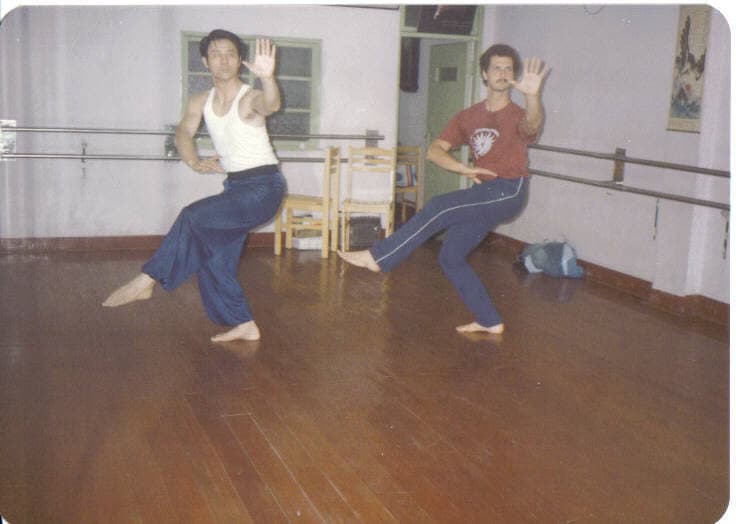
Hung offered Allen his “Chren bu” — “the whole ball” — and Allen returned to Taiwan in 1984 as a live-in student to receive the full transmission of Chang Chuen-Feng’s Hsing-I and Gao Ba-Gua. This was not a catalogue of movements but an education in how a system becomes embodied: form and application, tactics and judgment, training and recovery, health and fighting spirit, each part connected to the whole. Allen could not photograph Hung as a study aid, so after learning the movements he drew figures of everything. Hung approved of this record and entrusted him with Zhang’s system chart and a fighting poem. Weapons and work in the family’s bone-setting practice belonged to the education as well. Beyond the material itself, Hung gave Allen a measure for complete teaching: the practice had to work against another body, care for the body that carried it and remain a coherent whole.

Published studyAllen Pittman · My Physical Path (c. 2015–16) · Jess O’Brien, Nei Jia Quan (2004) · Léo Tamaki (2013)

B

Study, interpretation and writing

Robert W. Smith → Allen Pittman

Twenty-five years of form, principle, comparison and argument; Smith’s own Hsing-I drew on his teacher Yuan Tao, whose modified forms and Yunnan Lien Bu he passed on. Their collaboration returned the work to the page in Hsing-I, Pa-Kua and the combined volume Chinese Internal Boxing.

Published studyThe Single Palm Change of Sun Lu‑T’ang · Allen Pittman · Pa Kua Chang Journal, Vol. 3, No. 4 · 1993

C

Chen Pan-Ling family transmission

Chen Pan-Ling → Yun-Chao & Yun-Ching → Allen Pittman

Allen’s connection began through Robert W. Smith’s writing on Chen Pan-Ling. In Taiwan, with Marnix Wells’s help, he found one of Chen’s sons, who became his teacher and introduced him to his older brother. Allen studied directly with Yun-Chao and Yun-Ching, received permission from his teachers to teach what he had learned and brought their father’s forms — including the Hsing-I animal forms — back to Smith’s students. As Allen describes it, Chen’s project was preservation through condensation: gathering Hsing-I, Ba-Gua and Tai Chi into a curriculum clear enough to survive upheaval without erasing the character of the individual arts. Allen went on to teach the Chen Pan-Ling method; it also formed the basis of his books on Hsing-I and Pa-Kua with Smith. This is a living family transmission in Allen’s teaching, not an appendix to the Gao-Hung line and not the same route.

Published studyPa Kua Chang Newsletter, Vol. 1, No. 2 · 1991 · Allen Pittman, Internalwork interview · 2011 · My Physical Path (c. 2015–16)

Meet the teachers and influences

How Allen teaches

Receive the method. Build the freedom to use it.

Allen received more than outward sequences from Hung I-Mien: forms arrived with applications and a practical logic. Careful practice protects that basis; understanding makes it portable.

01

Receive form and function

A form is kept accurately, but not as an empty sequence. Direct applications preserve how its structure, timing and technical memory work against another body.

02

Embody the principles

Partner study turns balance, angle, change and force from explanations into capacities the body can recognise and test.

03

Make independence possible

A sound basis should lead beyond perpetual imitation. Principles, diagrams and comparison let the student meet new situations and develop applications without mislabelling adaptation as inherited form.

The wider martial education

Other arts taught the body different questions.

Judo, wrestling, fencing and weapon work gave Allen comparison, testing and historical depth, sharpening how he reads the internal arts.

01

Foundation

Tae Kwon Do · Judo · Kendo

Early striking, falling, grappling and formal discipline gave Allen practical reference points before the Chinese internal arts became central.

02

Ten years with Tim

Irish wrestling · Collar-and-Elbow & Catch

The old jacketed and grip-based wrestling of Ireland and the British Isles, received over ten years with Tim Geoghegan in Black Mountain. It changed how Allen understood leverage, ingenuity and conditioning.

03

Western research

Fencing · hoplite combat · armour

Épée, foil, shield, spear and armoured work widened the technical conversation and supported Allen’s historical and academic writing.

04

Manipuri study

Thang Ta with Khilton Nangmeithem

Sword and spear entered through Huyen Lallong, the method of safeguarding: a living meeting of weapon, culture and responsibility.

Continue through Allen’s work

Technical routes lead back to human relationships.